
Exciting News for the Natural Language Interaction Protocol (NLIP) and its Impact on Implementing AI Agent Ecosystems
Pete Harris
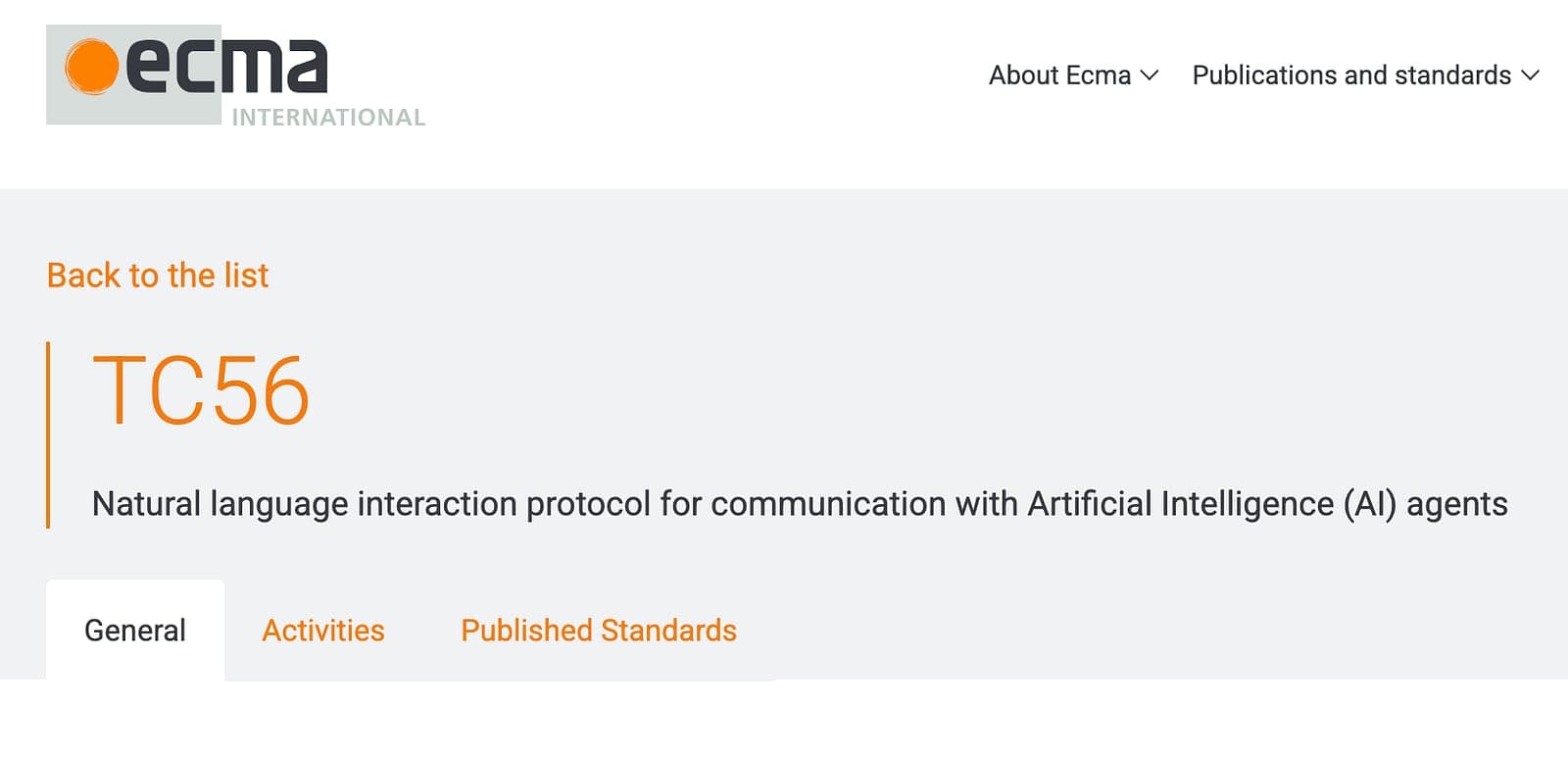
We have exciting news to share relating to a project that the Enterprise Neurosystem has been closely involved with. NLIP — short for Natural Language Interaction Protocol — has been recognized as a family of standards by Ecma International, a leading nonprofit industry organization focused on information and communication systems. We believe that NLIP can play a substantial role in the adoption of AI agents for real-life applications.
The NLIP standards collectively establish an open, secure foundation for AI agents to communicate across organizational boundaries and technology platforms, replacing hard-coded application programming interfaces with a universal envelope protocol. Ecma standards specifications are freely available and open source and reference implementations are available free of charge.
NLIP enables multi-turn conversational natural language exchanges between humans and AI agents, as well as agent-to-agent interaction, regardless of their organizational domains, internal technologies or supported transport mechanisms. It supports multi-modal interactions, including text, audio, video, images, and other sensor data.
The approach adopted by NLIP leverages Generative AI and eliminates many challenges associated with API management in current software systems and enables the development of universal client applications and agents that can communicate with any other NLIP-enabled application or agent. As such, NLIP is a perfect approach to adopt for those looking to build AI agent ecosystems. For more information on the standards, check out the Ecma announcement.
NLIP was incubated by the Enterprise Neurosystem, which helped form a community from industry and academia to develop it. The project is led by Dinesh Verma, an IBM Fellow who also serves on the Board of the Enterprise Neurosystem. Additionally, Enterprise Neurosystem supporter Kove sponsored NLIP development and implementation work undertaken at the University of Delaware.
Others involved in the project include: Elisa Bertino, Luyi Xing, Ranjan Sinha, Ph.D., Abhay Ratnaparkhi, Sean Hughes, Sanjay Aiyagari, Ted Ross, Mohamed Rahouti, Jinjun Xiong, Yohei Kawaguchi, Ashish Kundu, Ph.D., Tom Sheffler, Eric C., Patrick Luthi, and Samina Husain.
The project also benefitted from the support of the AI Alliance, a non-profit organization dedicated to building and advancing open source AI agents, data, models, evaluation, safety, applications and advocacy to ensure everyone can benefit. See Dinesh’s LinkedIn post for AI Alliance members and IBM staff who are deserving of thanks.
“This achievement is a testament to Dinesh Verma’s vision and leadership, as the NLIP team is directly accelerating the progress of the entire AI industry,” said Bill Wright, Chair of the Enterprise Neurosystem. “In practical terms, this will be especially useful for our own multinational AI network projects, and our community will be utilizing this protocol in production deployments going forward.”
The Ecma standardization — under the auspices of Technical Committee 56 (TC56) — helps to break the increasing lock-in that is appearing as various AI platforms customize their approaches. By using NLIP, an application or agent can interpret and relay requests to anyone, not just to proprietary platform participants. Moreover, the governance of NLIP is through standards, and not via a corporation or consortia with vested interests. Updates, licenses and rights are governed by the standard, and not by the ever-changing needs of shareholders.
Having focused to date on building open source implementations to validate the specifications and help standardization, the project team is now looking to develop robust open source implementations of NLIP.
This is a great opportunity for all to join these efforts. For more information on NLIP, check out the intro video here, and to become involved, please visit https://nlip-project.org.